What is UMDA?
UMDA is a layered blueprint for manufacturing data. It takes every sensor reading, production record, and ERP transaction and turns it into one trusted, contextualized source of insight by layering:
- Edge Intelligence Hubs that enrich local signals and publish them to a Unified Namespace the moment they leave a machine.
- Domain-specific Common Data Models that speak the same ISA-95 / ISA-88 language across plants.
- A governed data backbone — a knowledge graph, backed by shared ontologies, where analytics, AI agents, and compliance audits all draw from the same connected, lineage-tracked model.
At the enterprise tier, the Unified Data Layer is more than a set of tables: connected through shared ontologies, it forms a knowledge graph that links assets, processes, materials, and events, so analytics and AI can reason over context, not just rows.
With UMDA, manufacturers sidestep tangled point-to-point integrations and context-free data lakes. They gain real-time publish/subscribe pipelines, machine-verifiable data contracts, and a feedback layer that lets AI models learn continuously. Whether applied to a single pilot cell or a global network of plants, UMDA clarifies where every technology, standard, and team belongs, so organizations spend less time stitching data together and more time driving yield, quality, and sustainability.
The same plant, three ways
Five systems, two consumers. Toggle the architecture and watch what happens to the wiring — and to the meaning of the data.
Works for the first three systems. Every system after that multiplies the wiring — and the meaning of the data lives in nobody's documentation.
The data layer as a knowledge graph
Connected through shared ontologies, a single reading carries the full context around it, traversable rather than just stored.
From one reading, Vibration 4.2 mm/s on Reactor A, you can traverse to the batch it's running, the material it's consuming, the product it's making, the phase it's in, who's operating it, and the alert it raised. That's the difference between a number and a decision.
Core principles
The design principles that define the architecture, from edge to enterprise.
Every dataset is owned, documented, and SLA-backed.
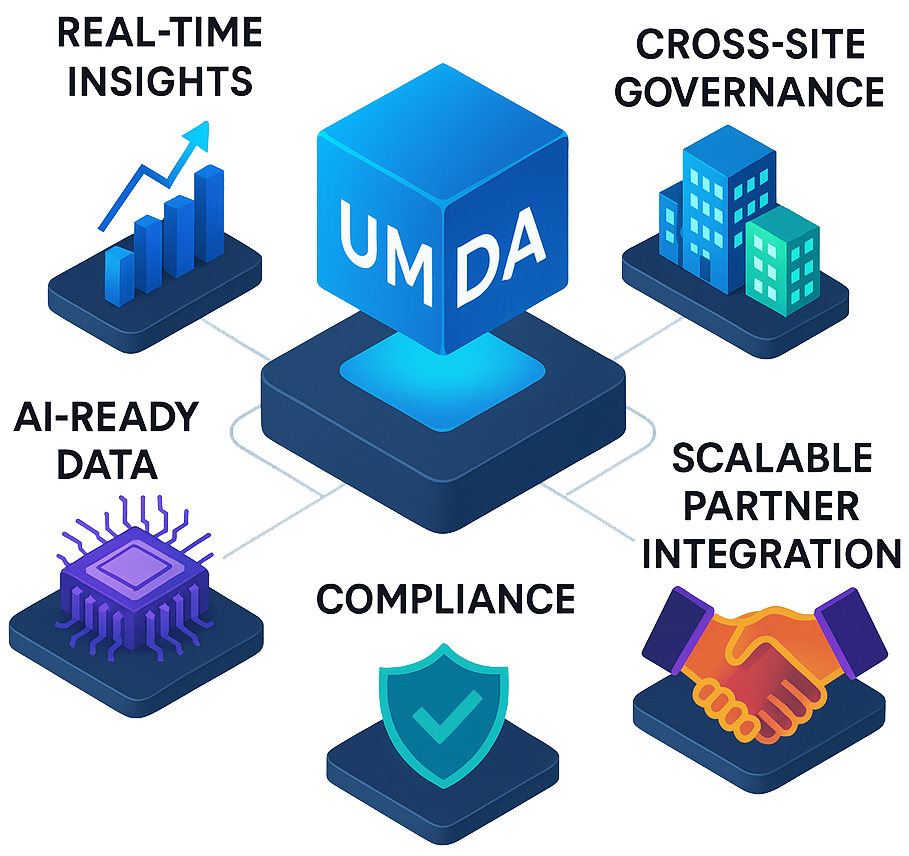
Schemas, units, quality rules, and delivery intervals are machine-verifiable, so data is AI-ready by default.
Entities and relationships form a knowledge graph, backed by shared ontologies, so context can be traversed and reasoned over, not just queried.
Context is added where data is born and shared globally in real time.
Layers map to ISA-95 / ISA-88 for clean hand-offs between control, MES, and enterprise systems.
Stewardship, lineage, zero-trust access, and audit trails are embedded from day one, aligned with GxP / 21 CFR Part 11.
Works with any compliant historian, lakehouse, or cloud, and standard contracts speed onboarding of new sites and partners.
AI insights route back to MES, QMS, and maintenance for continuous optimization.
Reusable patterns and data products allow sites, domains, and AI use cases to scale without rebuilding the foundation each time.
Frequently asked questions
Is UMDA open and free to use?
Yes. UMDA is an openly published, vendor-neutral framework. You can adopt it freely. There is no license to buy and no lock-in.
Is UMDA tied to a specific vendor or product?
No. It is built on open standards (ISA-95/88, OPC UA, MQTT, JSON Schema) and works with any compliant historian, broker, lakehouse, or cloud.
Can I extend or contribute to it?
Yes. Domain Common Data Models are designed to be extended, and the framework is meant to grow through shared reference implementations and community contributions.
How is UMDA different from a data lake?
UMDA layers contextual models, contracts, and governance on top of storage, so data is immediately actionable rather than just stored. See the interactive comparison above.
Does UMDA require a specific cloud?
No. Deploy on-prem, in hybrid environments, or in any major public cloud.
Can I keep my existing MES?
Yes. UMDA ingests from OPC UA, MQTT, historians, and SQL sources without requiring a rip-and-replace.
How does UMDA support compliance?
Data contracts, signature logs, and full lineage align with GxP and 21 CFR Part 11.
Is UMDA only for process industries?
No. It scales across discrete, batch, and hybrid manufacturing operations.
See how the layers fit together
Explore the six interoperating layers that carry context from the edge to the enterprise, or benchmark where your own operation stands.